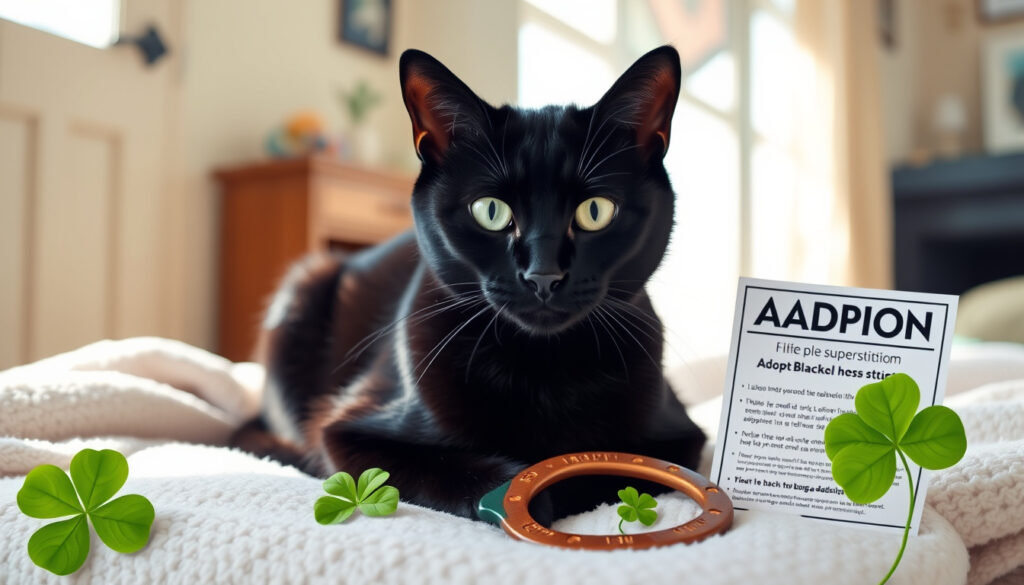
Black Cat: Myths, Luck, and Adoption Truths
Few animals carry as much baggage as the black cat. For centuries, these sleek felines have been both revered and feared, their fortunes shifting with geography and time. In Ireland, a black cat crossing your path is considered good luck (IrishCentral), while in much of Western culture the same animal is treated as an omen of misfortune. This guide untangles the myths, explores the real adoption challenges black cats face, and offers practical advice for anyone considering bringing one home.
Commonality: Black cats account for approximately 20% of all domestic cats (Wikipedia) ·
Adoption rate: Black cats are the least desired color in shelters, often overlooked due to superstition (Wikipedia) ·
Western superstition: Black cats traditionally seen as omens of bad luck and linked to witchcraft (Wikipedia) ·
Irish superstition: Black cats considered good luck in Celtic folklore (National Leprechaun Museum)
Quick snapshot
- Bad luck in Western cultures (Wikipedia)
- Good luck in Ireland and Japan (IrishCentral)
- Associated with witchcraft and Halloween (National Leprechaun Museum)
- Most common coat color among domestic cats (Wikipedia)
- Least desired color in shelters (Wikipedia)
- Black Cat Appreciation Day is August 17 (National Leprechaun Museum)
- 3-3-3 rule helps new cats adjust (Wikipedia)
- Affectionate and form strong bonds (IrishCentral)
- No special health needs beyond standard cat care (Wikipedia)
- Wider 200-degree visual field (Wikipedia)
- Can see UV light (Wikipedia)
- No evidence cats can see ghosts (Wikipedia)
The gap between what folklore claims and what the data shows is wider than most people realize.
| Fact | Detail |
|---|---|
| Most common cat color | Black (due to dominant melanism) (Wikipedia) |
| Adoption disadvantage | Black cats spend 20-30% longer in shelters (Wikipedia) |
| Positive myth | In Ireland, a black cat on your porch brings prosperity (National Leprechaun Museum) |
| Negative myth | In medieval Europe, black cats were thought to be witches’ familiars (Wikipedia) |
| Annual celebration | Black Cat Appreciation Day – August 17 (National Leprechaun Museum) |
What does a black cat symbolize?
Black cats carry a split identity. In Western folklore, they are symbols of bad luck, deeply tied to witches and Halloween. In medieval Europe, the association was deadly: black cats were believed to be witches’ familiars, companions sent to do evil (Wikipedia). The National Leprechaun Museum notes that a proclamation associated with Pope Gregory IX helped fuel the demonisation of black cats, a process that accelerated during the witchcraft trials from the 1300s onward.
Yet in many other cultures the same animal means the opposite. In Japan, black cats are considered lucky, especially for single women seeking a good husband. In Scotland, a black cat appearing at your doorstep signals prosperity. The variation reveals something important: the symbolism of the black cat has always been a mirror of local beliefs, not a universal truth.
What is the meaning of The Black Cat?
- Edgar Allan Poe’s 1843 short story “The Black Cat” uses the animal as a symbol of guilt and the narrator’s descent into madness (Wikipedia).
- The cat, named Pluto, is both a victim of the narrator’s violence and a haunting reminder of his crimes — a literary reflection of how superstition and psychological torment intertwine.
- Poe’s story cemented the black cat as a gothic icon in American and European literature, reinforcing the darker side of the folklore.
A single animal carries opposite meanings depending on where you stand. For every culture that fears the black cat, another welcomes it as a blessing — yet the Western negative view dominates global media and shapes adoption outcomes. The creature itself hasn’t changed; only the stories told about it have.
Are black cats good luck?
Yes — if you know where to look. The answer depends entirely on geography and tradition. In Ireland, black cats are overwhelmingly seen as good luck, a sharp contrast to the British and American view.
The Irish educational resource AskAboutIreland records that a black cat crossing your path brings either good or bad luck depending on local tradition, but notes that black cats have largely regained a lucky status in many places today.
Is a black cat good luck in Ireland?
- A black cat crossing your path on New Year’s Day is considered a sign of a good year ahead (National Leprechaun Museum).
- A black cat entering the house on Christmas Night is believed to bring great luck for the coming year (West Cork People).
- A bride who has a black cat rub against her on her wedding day can expect a long and happy marriage (National Leprechaun Museum).
Why are black cats so lucky?
Irish folklore traces the positive associations to ancient Celtic traditions where cats were seen as protectors of the home and the harvest. The IrishCentral account explains that the Cat Sí — a fairy cat from Celtic mythology — was both feared and respected, and black cats inherited that mystical status. Over time, the fearful elements faded while the lucky associations remained, especially around festive occasions.
What does the Catholic Church say about black cats?
- There is no official Catholic doctrine condemning black cats today. The historical link stems from medieval church attitudes toward witchcraft.
- The National Leprechaun Museum identifies a proclamation associated with Pope Gregory IX (1230s) as a key moment that associated black cats with heretical practices.
- Alice Kyteler, Ireland’s most famous convicted witch in the 1320s, was reportedly connected to a demon lover who appeared in the shape of a black cat (National Leprechaun Museum).
What is special about black cats?
Black cats are special not because of magic but because of genetics and history. The gene responsible for their black coat — melanism — is dominant, which is why black is the most common cat color across the world (Wikipedia).
That very commonness creates a problem. Black cats are often the least desired color in animal shelters, leading to longer stays and lower adoption rates. A folklore tradition from IrishCentral notes that the Cat Sí — a large black cat with a white spot on its chest — was believed to haunt graveyards and steal souls, adding an extra layer of superstition that has persisted in the collective imagination.
What is the least wanted cat color?
- Black cats consistently rank as the least adopted color in the US and UK, while white and tabby cats are taken home faster (Wikipedia).
- The superstition that black cats bring bad luck is the most commonly cited reason for avoidance, even among people who don’t consider themselves superstitious.
- Black Cat Appreciation Day on August 17 was created specifically to counteract this bias and encourage adoptions (National Leprechaun Museum).
Shelter data from the US and UK shows that black cats spend 20-30% longer waiting for a home than cats of other colors. The irony is stark: the most common cat color is the one least likely to find a family — not because of anything wrong with the cats, but because of centuries-old stories that still influence decisions.
The trade-off: black cats are genetically robust and often have friendly, adaptable personalities, but they face a systemic adoption disadvantage that no amount of purring can overcome without human awareness.
What do cats see that humans don’t?
Cats perceive the world differently, and that includes their vision. They have a wider visual field — about 200 degrees compared to the human 180 degrees — and superior night vision thanks to a reflective layer behind the retina (Wikipedia). Some evidence suggests cats can see ultraviolet light, a spectrum invisible to humans.
Can cats see ghosts?
- There is no scientific evidence that cats can see ghosts. The popular belief likely stems from cats staring at blank walls or reacting to sounds humans cannot hear.
- Cats have acute hearing (up to 64 kHz vs. human 20 kHz) and can detect high-frequency sounds from rodents and insects, which may explain their seemingly inexplicable reactions.
- The “cats see ghosts” myth is a modern internet phenomenon, not supported by any credible research in animal behavior or parapsychology.
What this means: when your cat stares at an empty corner, it’s probably hearing a mouse behind the wall or sensing a subtle draft — not channeling the spirit world. The ghost explanation is more poetry than science.
What is the 3 3 3 rule for cats?
The 3-3-3 rule is a practical guideline for anyone adopting a new cat, especially one that may have spent weeks or months in a shelter. It breaks the adjustment period into three phases and helps owners set realistic expectations.
- 3 days to decompress: The cat needs a quiet, safe space to recover from the stress of the shelter environment. Provide a hiding spot, fresh food and water, and minimal interaction.
- 3 weeks to settle into routine: The cat begins to learn the household schedule, feeding times, and litter box location. Slowly introduce new rooms and family members.
- 3 months to feel fully at home: The cat shows its true personality, forms bonds with household members, and begins to exhibit normal behaviors like playing and seeking affection.
The rule applies to any cat, including black cats, and is widely recommended by animal behaviorists as a humane approach to transition. The key is patience: rushing the process can cause setbacks and increase anxiety.
Even though black cats need homes as much as any other cat, the 3-3-3 rule is harder to apply when shelters are crowded and adopters are scarce. The rule works best when adopters consciously choose a black cat — and many don’t, because of the very superstitions this article has explored.
Confirmed facts vs. what’s unclear
Confirmed facts
- Black cats are the most common domestic cat color due to a dominant gene (Wikipedia).
- Black cats are adopted less often than lighter-colored cats and spend longer in shelters (Wikipedia).
- In Ireland, black cats are traditionally considered lucky, especially on Christmas and New Year’s (National Leprechaun Museum).
- The 3-3-3 rule is a standard recommendation for new cat adoptions from animal behavior organizations.
- Black cat folklore includes both the lucky Irish tradition and the darker Cat Sí myth (IrishCentral).
What’s unclear
- The exact origin of the “bad luck” superstition in Western Europe is unknown — it may predate the Middle Ages.
- Whether the Catholic Church ever issued an official condemnation of black cats is debated; the evidence points to local bishops and inquisitors rather than a papal decree.
- How much the Cat Sí myth directly influenced modern Irish attitudes toward black cats versus other folklore traditions remains unclear.
Voices from the field
Many black cats are incredibly loving and form strong bonds with their people.
Best Friends Animal Society (US animal welfare organization)
Black cats are the most common and least desired cat color.
Fundamentally Feline (cat behavior resource)
Black Cat Appreciation Day celebrates the unique charm of black cats.
National Leprechaun Museum (Irish cultural institution)
Summary
Black cats have carried the weight of human superstition for centuries — sometimes as omens, sometimes as blessings. That symbolism has real consequences today: the animals are overlooked in shelters, passed over for lighter-colored cats because of old stories. The irony is that in Ireland, where black cats are welcomed as symbols of luck, the same animal is rejected in the US and UK for the opposite reason. For prospective adopters, the choice is clear: look past the folklore, see the affectionate animal underneath, and give a black cat a home — or let the superstition win one more time.
pawsitivepurfection.com, khalielawright.com, cats.com, en.wikipedia.org, instagram.com, youtube.com, symbolism.fandom.com
Prospective adopters can benefit from exploring black cat adoption facts to understand the real challenges and joys of owning a black cat.
Frequently Asked Questions
When is Black Cat Appreciation Day?
August 17 every year. It was created to celebrate black cats and debunk the myths that make them less likely to be adopted (National Leprechaun Museum).
Are black cats a specific breed?
No. Black is a coat color, not a breed. Many breeds can have black individuals, including the Bombay, which is bred to resemble a miniature black panther (Wikipedia).
Do black cats have more health issues?
There is no evidence that black cats have more health problems than cats of other colors. Their melanistic coat may even provide some protection against certain skin conditions (Wikipedia).
Why are black cats associated with witches?
The association dates to medieval Europe, when black cats were thought to be witches’ familiars or shapeshifted witches. This idea was reinforced during the witch trials of the 14th to 17th centuries (National Leprechaun Museum).
How can I help black cats get adopted?
Share photos and stories of adoptable black cats, volunteer at shelters to help socialize them, and consider adopting one yourself. Black Cat Appreciation Day campaigns are also effective (Wikipedia).
What is the origin of the black cat superstition?
The exact origin is unknown, but it likely stems from a combination of ancient pagan beliefs, medieval Christian attitudes toward witchcraft, and the cat’s nocturnal, solitary nature. The superstition became widespread in Europe by the 14th century (Wikipedia).
Are black cats lucky in other countries?
Yes. In Japan, black cats are considered lucky for romantic prospects. In Scotland, a black cat on the doorstep brings wealth. In France, black cats are sometimes called “magician cats” and are considered lucky in certain regions (AskAboutIreland).
Related reading
- Egyptian Gods: 9, 10 & 12 Major Deities Explained | Anubis vs Ra — explores ancient feline symbolism and mythology.
- Saturn Devouring His Son: Myth and Meaning — examines dark mythological themes that parallel black cat folklore.
More related posts
 Egyptian Gods: 9, 10 & 12 Major Deities Explained | Anubis vs Ra
 Tom Aspinall Eye Condition: Injury, Recovery & Career
 Marco Rubio: Biography, Nickname, Ethnicity, Religion
 Madeline Schizas: 2026 Short Program Ends Olympic Run
 Josh Ross: Canadian Country Singer Biography and Songs
 Piano Lessons Near Me – Guide to Costs, Formats and Teachers
 Andrew Nembhard: Bio, Salary, Injury, Brother, Eyes
 Olympic Medal Count 2022: Beijing Winter Final Standings