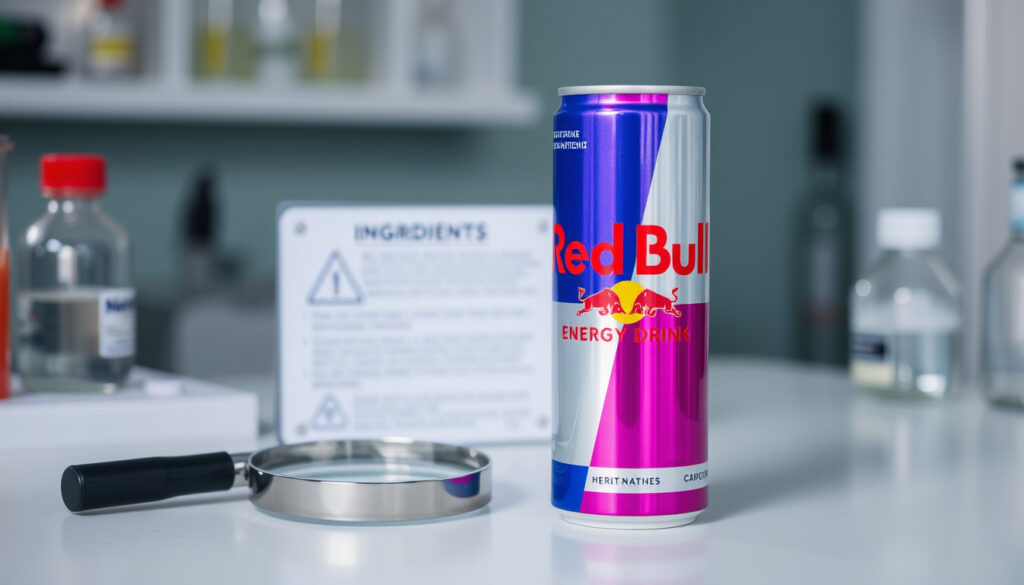
Red Bull Fact Check: Caffeine, Ingredients & Health Risks
That silver-and-blue can has been a fixture in gas stations and college dorms for decades, but most people who crack one open never stop to ask what’s actually inside. Red Bull is the world’s best-selling energy drink, yet its ingredient list, caffeine levels, and health effects remain surprisingly fuzzy for many drinkers.
Global market share: 13% ·
Caffeine per 250 ml: 80 mg ·
Sugar per 250 ml: 27 g ·
Founded: 1984 ·
Owner: Red Bull GmbH ·
Annual revenue (2022): €7.8 billion
Quick snapshot
- 8.4 fl oz can contains 80 mg caffeine (Red Bull official product page)
- 110 calories per 8.4 fl oz (Red Bull official product page)
- 27 g of sugars per 8.4 fl oz (Red Bull official product page)
- Exact sugar content varies by country and can size — the 8.4 fl oz label lists 27 g in the ingredient summary but 26 g in the nutrition declaration (Red Bull official product page)
- Database entries sometimes differ from label values due to ingredient variation (University Hospitals nutrition database)
- First sold in Austria in 1987 (Healthline)
- Now sold in more than 170 countries; owned by Red Bull GmbH (Healthline)
- Growing regulatory scrutiny on caffeine content and marketing to minors in Europe and North America
- Consumer demand for low-sugar and no-sugar variants continues to rise
Six key facts about Red Bull’s nutritional profile, one pattern: the numbers shift depending on which can size and which region you look at.
| Attribute | Value | Source |
|---|---|---|
| Caffeine (8.4 fl oz) | 80 mg | Red Bull official product page |
| Caffeine (12 fl oz) | 114 mg | Red Bull FAQ |
| Caffeine (16 fl oz) | 151 mg | Red Bull FAQ |
| Caffeine (20 fl oz) | 198 mg | Red Bull FAQ |
| Calories (8.4 fl oz) | 110 | Red Bull official product page |
| Sugars (8.4 fl oz) | 27 g (label) / 26 g (nutrition declaration) | Red Bull official product page |
| Sugars (12 fl oz) | 38 g | Smart & Final product listing |
| Niacin (B3 %DV) | 100% | Red Bull official product page |
| Vitamin B6 %DV | 250% | Red Bull official product page |
| Vitamin B12 %DV | 80% | Red Bull official product page |
| Sodium (8.3 fl oz database entry) | 214.2 mg | University Hospitals |
| First sold | 1987 (Austria) | Healthline |
Is Red Bull a healthy energy drink?
Red Bull is not marketed as a health drink, but that doesn’t stop people from wondering whether it’s “bad” for you. The answer depends on how much you drink and what you compare it to. A single 8.4 fl oz can contains 80 mg of caffeine — roughly the same as a small cup of coffee (Red Bull official product page). The caffeine content is the primary active ingredient, and peer-reviewed literature (PubMed / National Library of Medicine) identifies it as the main neurostimulant linked to adverse effects in energy drinks.
- One 8.4 fl oz can contains 27 g of sugar — about 6.5 teaspoons.
- The 12 fl oz can has 38 g of sugar, according to Smart & Final’s product listing.
- The American Heart Association recommends no more than 36 g of added sugar daily for men and 25 g for women. One large can pushes past that limit.
For a single, occasional can, the health impact is negligible for most adults. But the sugar load in larger sizes means regular consumption can quickly exceed daily sugar guidelines.
What this means: if you’re drinking Red Bull daily, the sugar content — not the caffeine — is likely the bigger concern for long-term health.
What exactly does Red Bull do?
Red Bull’s effects come from its combination of caffeine, taurine, B vitamins, and sugar. Caffeine blocks adenosine receptors, which delays the feeling of fatigue. Taurine — an amino acid — is included in the ingredient list but is not a stimulant; its role in energy drinks is still debated in the scientific literature (PubMed: The Dark Side of Energy Drinks). The B vitamins (niacin, B6, B12, pantothenic acid) help convert food into energy, but the amounts in Red Bull far exceed daily needs — 250% of the Daily Value for B6, for example (Red Bull official product page).
- The 8.4 fl oz can supplies 100% DV of niacin, 50% of pantothenic acid, 250% of vitamin B6, and 80% of vitamin B12.
- Ingredient list (from Red Bull official product page): carbonated water, sugar, glucose, citric acid, taurine, natural and artificial flavors, sodium bicarbonate, magnesium carbonate, colors, caffeine, niacinamide, pyridoxine HCl, calcium pantothenate, and vitamin B12.
The pattern: the B-vitamin content is more of a marketing feature than a functional necessity — your body dumps the excess.
How much caffeine is in Red Bull?
Caffeine content varies by can size. The standard 8.4 fl oz has 80 mg; the 12 fl oz has 114 mg; the 16 fl oz has 151 mg; and the 20 fl oz has 198 mg (Red Bull FAQ). For comparison, an 8 oz cup of brewed coffee has about 95 mg of caffeine. So a 12 oz Red Bull (114 mg) is actually stronger than a typical cup of coffee by volume.
One 12 fl oz can from a Smart & Final product listing confirms the 114 mg figure and also lists 38 g of total sugars. The Healthline (health information publisher) report warns that consuming more than four cans per day could raise the risk of caffeine overdose.
A 20 oz can of Red Bull delivers 198 mg of caffeine — nearly as much as two large coffees — but in a single serving that’s easy to drink quickly.
Why this matters: the can size you pick dramatically changes the stimulant dose, and the larger sizes bring you closer to the 400 mg daily limit that the FDA considers safe for most adults.
What are the benefits and risks of Red Bull?
Upsides
- Quick mental alertness from caffeine — comparable to coffee
- Convenient, portable, and widely available
- Contains B vitamins that support energy metabolism
- Zero alcohol content — safe for designated drivers
Downsides
- High sugar content — 27 g per 8.4 oz can, 38 g per 12 oz can
- Caffeine can cause jitters, anxiety, and sleep disruption
- Regular consumption tied to dental erosion, weight gain, and metabolic concerns
- Large cans can push caffeine intake above safe limits if drunk alongside other caffeinated beverages
The trade-off: the benefits are short-term and dose-dependent; the risks accumulate with frequency and volume.
Is Red Bull safe for daily consumption?
For most healthy adults, one 8.4 fl oz can per day is unlikely to cause harm, according to Healthline and general dietary guidelines. However, the peer-reviewed study in PubMed (National Library of Medicine) notes that energy drinks are associated with cardiovascular and neurological side effects, especially in adolescents and people with pre-existing conditions. The caffeine content alone isn’t the only concern — the combination of caffeine, sugar, and other ingredients may produce synergistic effects.
- Healthline recommends limiting Red Bull to no more than one 8.4 oz can per day.
- Consuming more than four 8.4 oz cans (~320 mg caffeine) could cause caffeine overdose symptoms.
- The American Academy of Pediatrics advises against energy drinks for children and teens.
What this means: daily consumption of a single small can is generally safe for adults, but the habit of reaching for a 12 oz or 16 oz can daily shifts the risk profile significantly.
What are the ingredients in Red Bull?
Red Bull’s ingredient list is consistent across its official sources. The complete lineup for the U.S. 8.4 fl oz version, as listed on the Red Bull official product page:
| Ingredient | Role | Notes |
|---|---|---|
| Carbonated water | Base | Standard soft-drink base |
| Sugar | Sweetener | 27 g per 8.4 oz |
| Glucose | Sweetener | Provides quick energy |
| Citric acid | Acidity regulator | Common food additive |
| Taurine | Amino acid | Often cited in energy drinks; not a stimulant |
| Natural and artificial flavors | Flavoring | Proprietary blend |
| Sodium bicarbonate | Buffer | Helps control pH |
| Magnesium carbonate | Anticaking agent | Also used in powders |
| Colors | Appearance | Includes artificial colors |
| Caffeine | Stimulant | 80 mg per 8.4 oz |
| Niacinamide (B3) | Vitamin | 100% DV |
| Pyridoxine HCl (B6) | Vitamin | 250% DV |
| Calcium pantothenate (B5) | Vitamin | 50% DV |
| Vitamin B12 | Vitamin | 80% DV |
The catch: the high B-vitamin levels are not harmful but unnecessary — your body excretes what it doesn’t use.
Is Red Bull an alcoholic drink?
No. Red Bull is alcohol-free. The confusion likely stems from the common practice of mixing Red Bull with vodka or other spirits, but the drink itself contains no alcohol. The Red Bull official product page lists no alcohol in its ingredients, and the product is classified as a non-alcoholic beverage.
The implication: if you’re concerned about alcohol content, you can drink Red Bull with confidence that it’s a soft drink — but adding liquor changes the equation entirely.
en.wikipedia-on-ipfs.org, caffeineinformer.com, organicauthority.com, en.wikipedia.org, us.horus-x.com, redbull.com, amazon.com
Frequently asked questions
Is Red Bull safe to drink every day?
For most healthy adults, one 8.4 fl oz can per day is considered safe by general dietary guidelines. However, Healthline advises limiting consumption to avoid excessive caffeine and sugar intake. Larger cans or multiple cans daily increase health risks.
Does Red Bull contain taurine?
Yes, taurine is listed in the ingredients of Red Bull. It is an amino acid that occurs naturally in the body and is added to many energy drinks. Its role in energy drinks is not fully understood, but it is not a stimulant (PubMed).
How much caffeine is in a can of Red Bull?
An 8.4 fl oz can contains 80 mg; a 12 fl oz can contains 114 mg; a 16 fl oz can contains 151 mg; and a 20 fl oz can contains 198 mg (Red Bull FAQ).
Is Red Bull gluten-free?
Yes, Red Bull does not contain gluten ingredients. The company states the product is gluten-free, but it is not certified.
Can Red Bull cause heart problems?
Excessive caffeine intake can cause palpitations, increased heart rate, and blood pressure spikes. A PubMed review notes that energy drinks have been linked to cardiovascular events, especially in vulnerable individuals.
Does Red Bull have sugar-free options?
Yes, Red Bull offers sugar-free and zero-calorie versions (Red Bull Sugarfree and Red Bull Zero) that use artificial sweeteners instead of sugar.
What is the price of Red Bull?
Prices vary by location and retailer. A single 8.4 fl oz can typically costs between $1.50 and $3.00 in the U.S. Multi-packs reduce the per-can cost.
Who owns Red Bull?
Red Bull is owned by Red Bull GmbH, a privately held company founded by Dietrich Mateschitz and Chaleo Yoovidhya. The company is headquartered in Fuschl am See, Austria.
For the average consumer who reaches for a Red Bull a couple of times a week, the drink is unlikely to cause harm. But for the daily drinker who buys the 16 oz can, the choice is clear: switch to a smaller size or a sugar-free variant, or face the accumulated consequences of 38 g of sugar and 151 mg of caffeine per serving.
More related posts
 Sault Ste. Marie Obituaries: Death Notices & Funeral Homes
 Toronto Catholic District School Board: Complete Guide
 Payday Loans Near Me: Ireland Options Dublin Cork
 Jonah Hill: Biography, Weight Loss, Brother’s Death & Net Worth
 Levi’s 501 vs 505 vs 511 vs Ribcage fit guide
 Stefano Faita: Biography of Canadian TV Chef & Brand Owner
 Jane Birkin: The Actress, Style Icon, and the Bag Named After Her
 Shai Gilgeous-Alexander Net Worth, Family & Career