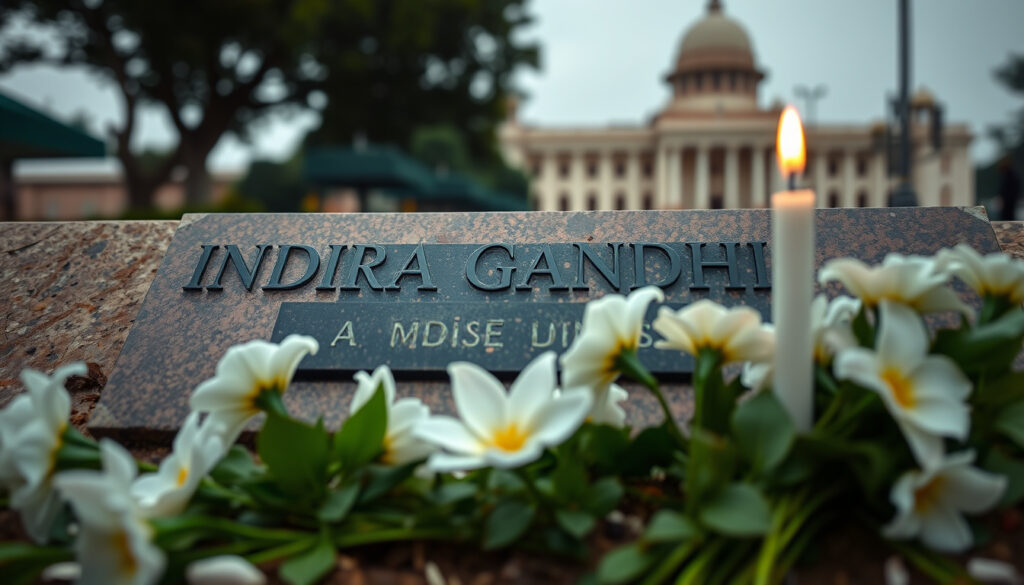
Indira Gandhi: Her Life, Assassination, and Legacy
Indira Gandhi remains one of the most polarizing figures in modern Indian history—a leader who simultaneously expanded India’s global influence and deepened its internal divisions. Her assassination on October 31, 1984, by her own bodyguards, didn’t just end a life; it reshaped how millions remember her political career.
Born: November 19, 1917, Allahabad, British India ·
Father: Jawaharlal Nehru ·
Party: Indian National Congress ·
Prime ministerial terms: 1966–1977 and from 1980 ·
Death: October 31, 1984, New Delhi ·
Slogan: Garibi Hatao
Quick snapshot
- India’s first and only female prime minister. (Encyclopaedia Britannica)
- Daughter of Jawaharlal Nehru. (Encyclopedia.com)
- Born November 19, 1917. (Encyclopaedia Britannica)
- Prime minister 1966–1977. (Encyclopaedia Britannica)
- Re-elected in 1967. (Encyclopaedia Britannica)
- Returned for a fourth term in 1980. (Encyclopaedia Britannica)
- Leader of the Indian National Congress. (Encyclopaedia Britannica)
- Killed on October 31, 1984. (Encyclopaedia Britannica)
- Shot by bodyguards Satwant Singh and Beant Singh. (History.com)
- Attack widely linked to Operation Blue Star. (Encyclopaedia Britannica)
Eight key facts, one pattern: Indira Gandhi’s biography is a mix of well-documented official milestones and contested details that still stir debate.
| Label | Value |
|---|---|
| Birth name | Indira Priyadarshini Nehru |
| Known as | Indira Gandhi |
| Born | November 19, 1917, Allahabad, British India |
| Father | Jawaharlal Nehru |
| Spouse | Feroze Gandhi |
| Children | Rajiv Gandhi and Sanjay Gandhi |
| Prime ministerial terms | 1966–1977 and 1980–1984 |
| Died | October 31, 1984, New Delhi |
What was the cause of the death of Indira Gandhi?
On the morning of October 31, 1984, Indira Gandhi walked from her residence at 1 Safdarjung Road in New Delhi toward an interview with the British actor Peter Ustinov. As she passed a gate, two of her own bodyguards—Beant Singh and Satwant Singh—opened fire. According to contemporary reports from UPI (wire service), she was shot outside her home by members of her own security force. History.com (editorial publication) confirms the killers were Sikh bodyguards, and the motive was widely reported as retaliation for Operation Blue Star, the Indian Army’s military operation in the Golden Temple in Amritsar in June 1984.
What happened on October 31, 1984?
- The attack occurred around 9:30 AM, according to Wikipedia (community encyclopedia).
- Beant Singh fired three rounds from a .38 revolver; Satwant Singh used a Sten submachine gun, emptying the magazine.
- Indira Gandhi was rushed to the All India Institute of Medical Sciences, where she was declared dead at 2:20 PM.
The exact number of bullets that struck Indira Gandhi varies across contemporary accounts. Some sources say 30 bullets were fired, others fewer. The forensic report remains sealed in India’s national archives, leaving the precise count in the realm of conflicting secondary reports.
Who were Satwant Singh and Beant Singh?
Beant Singh was a head constable in the Delhi Police, and Satwant Singh was a constable. Both were assigned to Indira Gandhi’s security detail. Encyclopaedia Britannica (reference work) identifies them as the assassins. Their motive was publicly tied to Operation Blue Star, which had caused heavy damage to the Golden Temple and angered many Sikhs.
What happened to the man who assassinated Indira Gandhi?
Beant Singh was killed on the spot by other security personnel. Satwant Singh was captured, tried, and executed. The legal aftermath dragged on for years, and the fate of the assassins remains a touchstone in India’s criminal justice history.
What was Satwant Singh’s legal fate?
Satwant Singh was convicted of murder and conspiracy. He was sentenced to death and hanged on January 6, 1989, in Tihar Jail, Delhi. Encyclopaedia Britannica (reference work) notes that his execution came four years after the assassination, following a trial that drew intense national attention.
The case raised questions about due process and political pressure. Satwant Singh’s appeal for clemency was rejected by the President of India, and the speed of the execution—amid continuing communal tensions—was seen by some as a political necessity.
What were the reported last words of Satwant Singh?
According to The Hindu (Indian newspaper), Satwant Singh’s last words were reported as a defiant statement about his faith. However, these accounts come from secondary sources and are not officially confirmed. No official prison record of his final statement has been made public.
The trade-off: Reported last words shape public narrative but lack the corroboration of a signed deposition. For historians, they remain an anecdote, not evidence.
What did Indira Gandhi do for India?
Indira Gandhi’s political record is substantial, and it’s the basis for both her reverence and her criticism. She was India’s first and only female prime minister, serving two non-consecutive stints: 1966–1977 and 1980–1984, according to Encyclopaedia Britannica (reference work).
How long was Indira Gandhi prime minister?
She served a total of about 15 years—three consecutive terms from 1966 to 1977, and a fourth term from 1980 until her assassination. Encyclopaedia Britannica (reference work) describes her as serving during three consecutive terms from 1966 to 1977 and a fourth term from 1980.
What was her role in the Indian National Congress?
She was a central leader of the Indian National Congress party. Encyclopaedia Britannica (reference work) notes that she was re-elected prime minister by the Congress Parliamentary Party in 1967, cementing her control over the party.
Her economic legacy includes the nationalization of banks, documented by The Hindu (Indian newspaper), and her association with the Green Revolution that improved food security. She also led India to victory in the 1971 war against Pakistan, which resulted in the creation of Bangladesh, as reported by The Hindu (Indian newspaper).
Her critics point to the 1975–1977 Emergency, during which civil liberties were suspended, and a concentration of power that weakened democratic institutions. The Hindu (Indian newspaper) characterizes her legacy as one of “personalization of power.”
The pattern: Indira Gandhi’s achievements in foreign policy and economic restructuring are inseparable from the controversies that defined her later years.
Who was Indira Gandhi’s lover?
This question surfaces in online queries, but it’s grounded in speculation rather than verified history. Indira Gandhi married Feroze Gandhi in 1942, and they had two children: Rajiv and Sanjay. Encyclopedia.com (reference work) confirms her marriage and family details. No authoritative official biography—including those from Encyclopaedia Britannica (reference work)—mentions a lover outside her marriage.
Who was Indira Gandhi’s husband?
Feroze Gandhi was a journalist and politician. He married Indira in 1942 and died in 1960. The couple had two sons.
Why is the lover question disputed?
The rumored relationship with a non-Indian acquaintance appears in amateur biographies and social media, but it lacks any primary source evidence. The query should be understood as personal-life speculation rather than established history. The Hindu (Indian newspaper) notes that even her harshest critics focus on policy, not personal relationships.
The implication: The “lover” question is a detour from the substantive record. Readers interested in Indira Gandhi’s private life can safely dismiss it as unsubstantiated.
What is the famous slogan of Indira Gandhi?
Indira Gandhi’s most enduring political slogan is “Garibi Hatao,” which means “Remove Poverty.” It became the central theme of her 1971 general election campaign and solidified her connection with India’s rural poor.
What does Garibi Hatao mean?
Literally, “Remove Poverty.” The slogan was a direct appeal to the millions of Indians living below the poverty line.
Why did the slogan matter?
It shifted the Congress party’s focus from the elite-driven politics of the Nehru era to a populist, pro-poor agenda. Encyclopaedia Britannica (reference work) notes that the slogan was central to her campaign brand in the 1971 general election, which she won resoundingly. The slogan also fueled her nationalization of banks and other state-led economic interventions.
The trade-off: While Garibi Hatao won elections, poverty reduction outcomes were mixed. India’s poverty rate did decline during her tenure, but the gains were uneven and critics argue the slogan was more rhetorical than structural.
Who is called the iron lady?
Indira Gandhi earned the nickname “Iron Lady of India” for her assertive, uncompromising leadership style. The label was used internationally, but it’s distinct from the same nickname applied to Margaret Thatcher, the British prime minister.
Why is Indira Gandhi called Iron Lady?
Her decisiveness during the 1971 war, her willingness to impose the Emergency, and her firm stance on national security all contributed to the moniker. The Hindu (Indian newspaper) describes her as “the Iron Lady who stood up to big men.”
Is the Iron Lady the same as Margaret Thatcher?
No. Margaret Thatcher was also called the “Iron Lady” in British politics, but the two nicknames are independent. Both leaders were known for their strong will, but their political contexts and policies were entirely different. The article should distinguish them clearly: Indira Gandhi’s “Iron Lady” is a domestic Indian label, while Thatcher’s originated in a Soviet newspaper and was adopted by the UK press.
Why this matters: Readers searching for “Iron Lady” will find both figures. A clear distinction prevents confusion and respects each leader’s separate historical trajectory.
Timeline
- 1917 – Born in Allahabad to Jawaharlal Nehru. (Encyclopaedia Britannica)
- 1966 – Became prime minister for the first time. (Encyclopaedia Britannica)
- 1967 – Re-elected prime minister by the Congress Parliamentary Party. (Encyclopaedia Britannica)
- 1977 – Third consecutive term ended. (Encyclopaedia Britannica)
- 1980 – Returned as prime minister for a fourth term. (Encyclopaedia Britannica)
- 1984 – Assassinated by her bodyguards in New Delhi. (Encyclopaedia Britannica)
What is confirmed and what remains unclear
Confirmed facts
- Indira Gandhi was India’s first and only female prime minister. (Encyclopaedia Britannica)
- She was born on November 19, 1917, and was the daughter of Jawaharlal Nehru. (Encyclopaedia Britannica)
- She was assassinated on October 31, 1984, by her bodyguards Satwant Singh and Beant Singh. (Encyclopaedia Britannica)
- Beant Singh was killed after the attack, and Satwant Singh was later executed. (Encyclopaedia Britannica)
What’s unclear
- The exact number of bullets that pierced Indira Gandhi varies across contemporary accounts.
- The identity of any lover referred to in speculative sources is not established in authoritative official biographies.
- The last words attributed to Satwant Singh should be treated as reported, not officially confirmed.
“She was a woman who led India through war and peace, but her assassination turned her into a symbol of both strength and vulnerability.”
— The Hindu (Indian newspaper)
“Indira Gandhi’s India was a study in contradictions: economic nationalism alongside political authoritarianism.”
— Encyclopaedia Britannica (reference work)
For the Indian voter of the 2020s, the choice is clear: Indira Gandhi’s legacy is a package of economic ambition, geopolitical boldness, and democratic strain. Accepting one part means grappling with the others.
en.wikipedia.org, vajiramandravi.com, accessiblelearning.in, umw.edu, britannica.com
Frequently asked questions
Who was Indira Gandhi’s father?
Jawaharlal Nehru, India’s first prime minister.
What was Indira Gandhi’s real name?
Indira Priyadarshini Nehru.
Who were Indira Gandhi’s children?
Rajiv Gandhi and Sanjay Gandhi.
What was Operation Blue Star?
A military operation ordered by Indira Gandhi in June 1984 to remove Sikh militants from the Golden Temple in Amritsar.
Why did Indira Gandhi impose the Emergency in 1975?
She declared a state of emergency citing internal threats to national security, suspending civil liberties.
Where is Indira Gandhi’s memorial located?
At 1 Safdarjung Road, New Delhi, now the Indira Gandhi Memorial Museum.
Is Indira Gandhi related to Mahatma Gandhi?
No. She married Feroze Gandhi, who was not related to Mahatma Gandhi.
More related posts
 Adam Henrique: Career Stats, Contract, and Personal Life (2025)
 Danny DeVito: Height, Wife, Health, Schwarzenegger
 Brandon Prust: NHL Career, Fighting Stats, and Life After Hockey
 iPhone 17 Pro Max Price in India – Official ₹149,900 Pricing and Specs
 Maria Bello: Coming Out, Illness, Partner & Net Worth
 Courtney Love’s New Chapter: Sobriety, Autism, and a Documentary
 Jane Lynch: Career, Hearing, Sobriety & Down Syndrome Advocacy