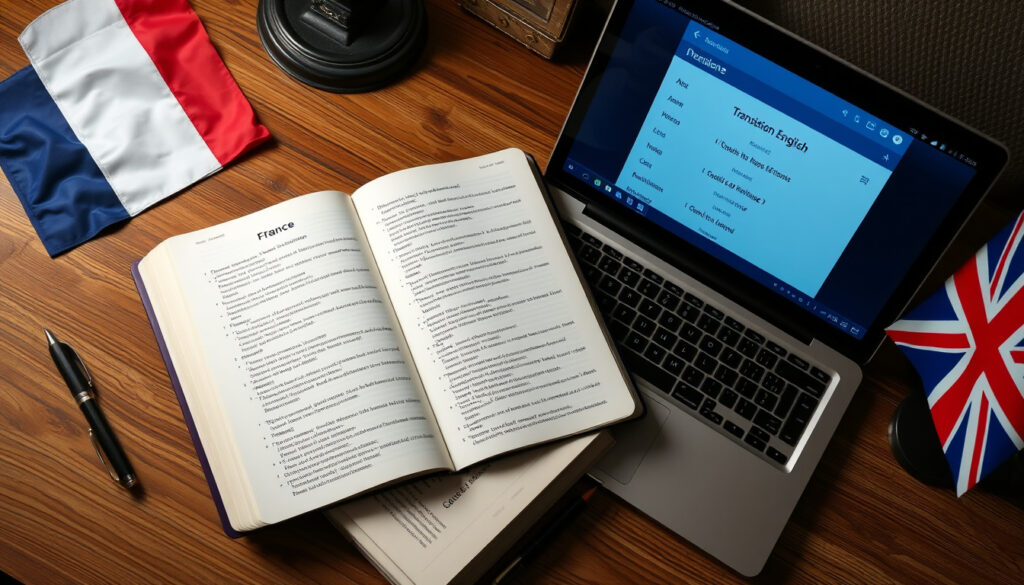
French Translate to English: Best Tools and Phrases
French menus, conversations, and documents don’t have to feel like puzzles. The translation tools available in 2026 are smarter, faster, and more accurate than anything available just a few years ago — but “good enough” varies wildly depending on which one you pick. This guide cuts through the noise with a side-by-side comparison of the leading services and answers to the specific French phrases people search for most.
Languages Supported by Google Translate: 130+ ·
DeepL Daily Users: Millions daily ·
Collins Features: Audio Examples ·
Reverso Languages: 15 supported ·
Top Free Apps Listed: 10+
Quick snapshot
- Google Translate free and instant (Maestra.ai)
- Daily user counts differ across sources for some tools (Rick Steves Forum)
- DeepL established as gold standard for European languages including French (Doctor eLearning)
- AI translation accuracy continues improving across all major platforms
Five major platforms compete for French-English translation supremacy, each optimized for different user priorities — from pure language count to professional document handling.
| Tool | Languages | Key Strength | Free Tier | Premium Price |
|---|---|---|---|---|
| Google Translate | 130+ | Offline support, multi-modal | Yes | Free |
| DeepL | 30+ | AI accuracy, natural phrasing | Limited | $8.74/mo |
| Microsoft Translator | 100+ | Teams integration, offline | Yes | Free/API |
| Reverso | 15 | Contextual examples, learning | Yes | $6.49/mo |
| SYSTRAN Translate PRO | 55 | Secure, industry-specific | No | $5.49/mo |
What is the most reliable translator for French?
When French teachers in France rank translation tools, one name consistently rises to the top: DeepL outperforms every other option in producing translations that feel natural and contextually accurate to native speakers, according to the Rick Steves travel forum community (Rick Steves Forum). That said, the “most reliable” choice depends heavily on your use case — whether you need casual conversations, professional documents, or offline support.
Google Translate
Google Translate remains the most versatile free option, supporting 130+ languages including French, with text, camera, voice, and offline modes across web, iOS, and Android (Maestra.ai). The service excels for casual use — translating menus, signs, and quick phrases — and its offline mode makes it ideal for travelers who won’t always have WiFi.
Google Translate covers 130+ languages for free, making it the widest net for casual French translation needs.
DeepL Translator
DeepL’s AI engine produces fluent, context-aware French translations that often surpass other major tools — a claim backed by multiple independent comparisons (Maestra.ai). French teachers in France confirm its superiority for nuanced, professional-level translations. The trade-off: DeepL supports only 30+ languages compared to Google Translate’s 130+.
DeepL remains the gold standard for “feeling” human. Its neural networks are particularly adept at European languages (French, German, Spanish). — Doctor eLearning (2026 Automated Translation Guide)
Collins Dictionary
Collins sets itself apart with audio support — a critical feature for learners working on pronunciation. Example sentences accompany translations, and the French-English focus means better contextual entries than general-purpose tools.
The implication: for learners prioritizing speaking and listening comprehension over reading, Collins Dictionary with its audio examples fills a gap that pure text translators leave open.
What is the best free French translation app?
The free tier market for French translation has consolidated around a handful of strong performers, each with distinct strengths. Whether you need quick voice translation, offline support, or contextual learning tools, there’s a free option designed for your specific workflow.
Reverso offers free text translation alongside contextual examples and learning tools, differentiating itself from purely mechanical translators.
Top Free Options
- Google Translate — free, instant, supports 130+ languages including French with offline mode
- DeepL — free basic version with AI-powered accuracy for French translations
- Reverso — free online text translation with contextual examples and learning tools
- Microsoft Translator — free with offline French support, voice recognition, and image translation
The pattern across these top performers: free tools now routinely match or exceed what paid-only services offered just three years ago.
Features Comparison
Talk & Translate uses Collins Premium dictionaries for speech, text, and photo translation, with offline mode available in premium at $69.99/year (AmazingTalker). While not free, it represents the premium ceiling for dedicated French-English voice translation.
User Recommendations
Travelers in France report that Google Translate and DeepL together cover almost any scenario — Google for offline capability and breadth, DeepL for nuanced conversations and document work (Rick Steves Forum).
The catch: no single app handles every French translation scenario perfectly. Power users typically keep two or three apps installed for different contexts.
What is “I love you” in French Canadian?
The phrase “je t’aime” translates the same way in Canadian French as in European French — the core phrase doesn’t change — but pronunciation and regional context add layers that machine translation often misses.
Standard Pronunciation
“Je t’aime” is pronounced approximately “zhuh-TEHM” in standard French. The key is the liaison between “je” and “t'” — a sound that connects the two words rather than separating them. Collins Dictionary provides audio examples that demonstrate this nuance clearly.
Regional Variations
French Canadian (Québecois) maintains “je t’aime” as the romantic expression, though the accent and certain vocabulary items differ from France French. Quebec speakers often pronounce vowels more openly, which can affect how the phrase sounds to European French ears.
Usage Tips
- Formal romantic: “Je t’aime” — appropriate in any French-speaking region
- Casual affection: “Je t’aime bien” — “I like you” or friendly love
- Intensive: “Je t’aime tellement” — “I love you so much”
The practical takeaway: use “je t’aime” with confidence regardless of which French-speaking region you’re addressing — the phrase’s meaning holds consistently across dialects.
Is it polite to say “de rien”?
“De rien” — literally “of nothing” — functions as the French equivalent of “you’re welcome.” Whether it’s considered polite depends on context, region, and the relationship between speakers.
While technically correct, “de rien” registers as casual. In formal or professional settings, “je vous en prie” carries more formality and is often expected.
Polite Responses in French
- De rien — casual, friendly, appropriate with peers
- Je vous en prie — formal, professional, shows respect
- Il n’y a pas de quoi — formal, slightly old-fashioned
- Avec plaisir — “with pleasure,” warm and appreciated
Alternatives
The most versatile polite response is “je vous en prie,” which works in both formal and semi-formal settings. For close relationships, “de rien” feels natural and warm.
Context Usage
In Paris cafés, you’ll hear “de rien” used routinely between strangers — it’s not rude, just casual. In business contexts or with elders, defaulting to “je vous en prie” shows linguistic sophistication.
What this means: matching your response to the social register of the interaction signals cultural awareness. French speakers notice when you do this correctly.
What does “à côté de” mean?
“À côté de” translates to “next to” or “beside” in English. It’s a prepositional phrase that describes physical position or, figuratively, comparative status.
Literal Translation
Literally: “at the side of.” The phrase breaks down as:
- à côté = at the side / beside
- de = of (establishing what it’s beside)
Common Uses
- Physical position: “La chaise est à côté de la table” — “The chair is next to the table”
- Comparative: “À côté de lui, je suis nul” — “Compared to him, I’m terrible”
- Proximity: “J’habite à côté de l’école” — “I live near the school”
Example Sentences
- “Le livre est à côté de l’ordinateur” — “The book is beside the computer”
- “À côté de mes problèmes, les vôtres sont simples” — “Compared to my problems, yours are simple”
- “Je me suis garé à côté du café” — “I parked next to the café”
“À côté de” is one of the first prepositional phrases French learners encounter because it covers both physical proximity and figurative comparison — two concepts that come up constantly in conversation. — Mezzo Guild (French Learning Resources)
The implication: mastering “à côté de” unlocks two separate types of expression — spatial and comparative — making it one of the highest-return phrases to memorize early in French study.
How to Get the Most Accurate French Translations
Beyond picking the right app, how you use translation tools significantly affects output quality. These steps help you get professional-grade results from any platform.
- Choose Your Context: Determine whether you need casual conversation accuracy (Google Translate), professional document quality (DeepL), or learning support (Reverso). Each tool optimizes for different priorities — using the wrong one for your use case introduces unnecessary errors.
- Use Voice Mode for Pronunciation: Google Translate and Microsoft Translator offer voice input that helps you practice pronunciation while getting instant feedback. Collins Dictionary provides audio examples that demonstrate correct French pronunciation without the mechanical sound of synthetic voices.
- Verify Nuances with Contextual Tools: For anything beyond casual phrases, cross-reference with Reverso or Linguee, which provide bilingual dictionary examples showing how native speakers actually use terms in context. This catches idiomatic expressions that direct translation misses.
- Leverage Document Translation for Longer Texts: DeepL supports document translation (Word, PPT, PDF) with custom glossaries — useful for professionals translating legal or technical French content. This preserves formatting while maintaining terminology consistency across long documents.
- Test Multiple Services for Important Content: For critical translations, run your source text through both Google Translate and DeepL, then compare outputs. Where they differ, research the discrepancy — this catches errors that a single tool might miss (Copycat Cafe).
Machine translation still struggles with French idioms, sarcasm, and regional slang. For high-stakes communications, always have a native speaker review the output.
ChatGPT, Google Translate, and DeepL Translator did the best job on sample French dialogue, including subtle touches like filler words that make translation feel natural. — Copycat Cafe
convey911.com, sonix.ai, smartling.com, adverbum.com, atanet.org, youtube.com
Much like the tools we recommend, best translators compared for French to English reveal DeepL’s edge in handling idiomatic phrases accurately.
Frequently asked questions
What is the most common French phrase?
“Bonjour” (hello/good day) is the most common French greeting and one of the first phrases learners encounter. In everyday conversation, “ça va?” (how’s it going?) and “merci” (thank you) are equally ubiquitous.
What does “Foo Foo” mean in French?
“Foo foo” is not a standard French phrase. It may be a playful or nonsense term, or possibly a misunderstanding of a similar-sounding French word. If you encountered this term, double-check the spelling or context.
Can I say “c’est bon”?
“C’est bon” means “it’s good” or “that’s fine.” It’s appropriate in casual contexts — agreeing that something is acceptable or satisfactory. In formal settings, “c’est acceptable” or “c’est satisfaisant” sound more polished.
What is “fattie” in French?
The French translation depends on context: “gros” for a male, “grosse” for a female, or “personne ronde” for a more neutral description. Note that direct translations of body descriptors carry different social weight than in English.
How to translate French to English sentences?
Enter the French text into Google Translate, DeepL, or Reverso, then review the English output. For accuracy, compare results across multiple tools and use Reverso or Linguee to check contextual examples before finalizing.
What is English to French translation with pronunciation?
Collins Dictionary and Talk & Translate provide audio pronunciation guides alongside text translations. Google Translate offers phonetic spelling and audio playback for both English and French pronunciations.
What does “translate English to French informal” mean?
Informal French translation uses casual register — spoken French, texting abbreviations, colloquial expressions. This differs from formal written French which uses formal pronouns (“vous” vs “tu”) and more complex grammatical structures. Specify your register need when using translation tools.
Looking for other translation guides? Translate English to Filipino – Top Free Tools and Apps covers Southeast Asian language options, while Le Jeu du Calmar – Plot, Games, Season 2 Explained explores French cultural content.
More related posts
 Ray Lewis: Hall of Fame Linebacker and Controversy
 Judge Judy 2024: Age, Net Worth, Career & Family Updates
 Joe Cocker: Biography, Death, and Lasting Legacy
 Flights to Las Vegas: Cheapest Months, Direct Routes & Tips
 IIHF World Championship 2025: USA Wins Gold in OT
 Social Determinants of Health: Definition, Examples, Domains
 Ed Sullivan Cause of Death and His TV Legacy
 Tokyo Skytree: Complete Guide to Japan’s Tallest Tower