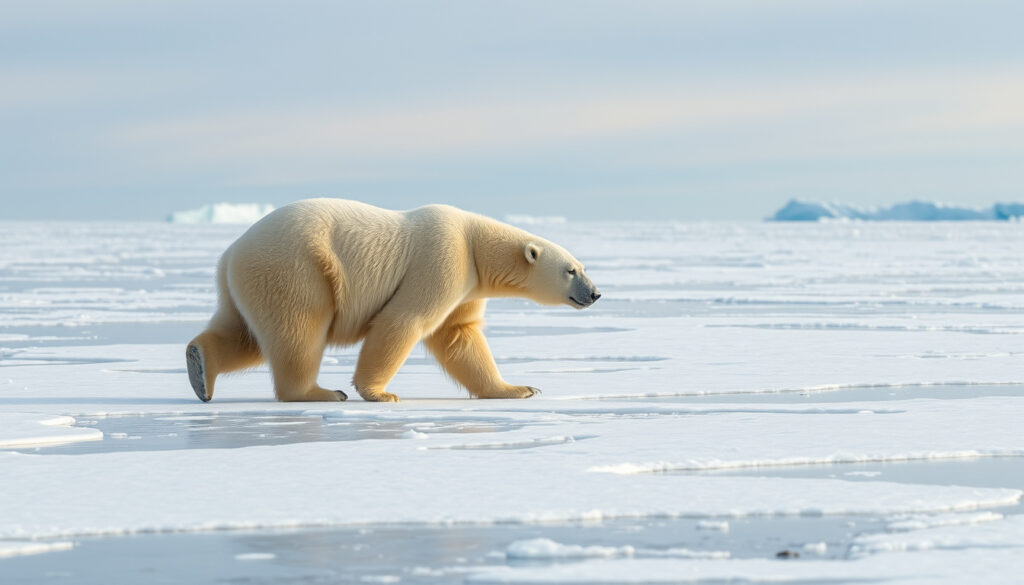
Polar Bear Facts: Size, Habitat, Threats & More
There’s something quietly stubborn about an animal whose entire world is frozen ocean. Polar bears chase seals across Arctic sea ice that is vanishing beneath them, and the numbers show the strain: WWF Arctic (Arctic conservation program) estimates 22,000 to 31,000 bears remain, while World Wildlife Fund (global conservation group) projects a 30% decline by 2050 as the ice retreats.
Adult male weight: 300–800 kg (660–1,760 lb) ·
Projected population decline by 2050: 30% ·
Travel distance per month: 3,000 km ·
Lifespan in the wild: 20–25 years
Quick snapshot
- Polar bears are the largest bear species and the Arctic’s top land predator (WWF Arctic (Arctic conservation program)).
- Adult males weigh 300–800 kg (660–1,760 lb). (WWF Arctic (Arctic conservation program))
- The species lives only in the Arctic, across five Arctic nations (WWF UK (U.K. conservation charity)).
- Whether polar bears can adapt to much longer ice-free seasons (Polar Bears International (polar bear research group)).
- How effective localized conservation efforts will be as the ice edge keeps moving. (Polar Bears International (polar bear research group))
- 2008: Listed as threatened under the U.S. Endangered Species Act (U.S. Marine Mammal Commission (federal science agency)).
- 2015: Classified as vulnerable on the IUCN Red List (WWF Arctic (Arctic conservation program)).
- 2050: Projected 30% global population decline (World Wildlife Fund (global conservation group)).
- Hunting habitat keeps shrinking as sea ice retreats.
- Pollution, Arctic industrial activity, and overharvest add pressure on top of habitat loss.
Six numbers, one pattern: every measurement on this list is built for extreme cold, heavy travel, and marine hunting.
| Attribute | Value |
|---|---|
| Scientific name | Ursus maritimus |
| Adult male weight | 300–800 kg |
| Adult male length | 2.4–3.0 m |
| Lifespan (wild) | 20–25 years |
| Top speed (land) | 40 km/h |
| Swimming speed | 10 km/h |
What Are 5 Facts About Polar Bears?
Most polar bear fact lists recycle the same handful of headline numbers. The five below are the ones with the strongest conservation-science backing, and each one connects directly to the Arctic’s biggest unresolved problem.
- The largest land carnivore. Polar bears outweigh every other bear species, and adult males typically reach 300–800 kg (660–1,760 lb) — Field & Stream (outdoor and wildlife magazine) calls the polar bear the biggest bear on the planet.
- Arctic-only range. The species circles the North Pole across Canada, Alaska (U.S.), Russia, Svalbard (Norway), and Greenland (Denmark), and it appears nowhere else on Earth.
- Built like a marine mammal. The U.S. Marine Mammal Commission (federal science agency) classifies polar bears as primarily marine mammals because their bodies — from large front paws built for swimming to blubber thick enough for Arctic water — are adapted to hunting seals from the ice.
- Travel machines. A single bear can cover roughly 3,000 km in a month while following the seasonal ice edge in search of prey.
- A climate-driven threat. Sea-ice loss is the central danger, and projections converge on a 30% population decline by 2050 as hunting habitat disappears.
The pattern: polar bears are not struggling because something outcompetes them. They are struggling because the frozen surface they hunt from is disappearing under their feet.
Who Is Bigger: a Grizzly or a Polar Bear?
Short answer: the polar bear wins on almost every measure. Field & Stream (outdoor and wildlife magazine) notes that polar bears are larger than grizzlies on average, while the largest brown bears can nearly match the largest polar bears — but that is the far end of the curve, not the middle.
Size Comparison Table
Size is the clearest separator between the two species — but the gap narrows at the extreme top end, where a big coastal brown bear can rival a large male polar bear.
Seven measurements, one pattern: every row shows a polar bear built bigger and more marine-adapted, while the grizzly stays lighter, more terrestrial, and better suited to inland forests.
| Measurement | Polar bear | Grizzly bear |
|---|---|---|
| Male body mass | 300–800 kg | 180–360 kg |
| Shoulder height | Up to 1.6 m | Up to 1.5 m |
| Hunting habitat | Sea ice and Arctic waters | Terrestrial ranges |
| Hibernation pattern | Pregnant females only | Most adults hibernate |
The terrestrial-versus-sea-ice split matters beyond size: polar bears are tied to the ice edge, while grizzlies roam inland — which is why their conservation stories are so different.
The catch: average size says “polar bear,” but maximum size says “brown bear.” Anyone comparing the two should separate those numbers, because a top-end grizzly and a top-end polar bear are closer than most people assume.
Are Polar Bears Arctic or Antarctic?
Arctic — and only Arctic. Polar bears evolved on the Northern sea ice, and their range stretches across Canada, Alaska, Russia, Svalbard, and Greenland (WWF UK (U.K. conservation charity)).
Antarctica has no native polar bears. The Southern Ocean never offered the sea-ice hunting platform this species depends on, and the U.S. Marine Mammal Commission (federal science agency) describes polar bears as marine mammals that hunt seals from the ice — a strategy that only works where seasonal sea ice forms reliably.
The Arctic-only range is exactly why climate change hits this species so hard: polar bears cannot simply shift south into colder waters, because the continents and the ice edge block that path.
The implication: polar bear conservation is Arctic conservation. There is no backup habitat on Earth waiting for this animal.
What Is the Lifespan of a Polar Bear?
In the wild, polar bears typically live 20–25 years; in captivity, with regular food and veterinary care, they can pass 30 (Polar Bears International (polar bear research group)).
Wild vs Captivity
- Wild: 20–25 years is the typical span, with females often outliving males.
- Captivity: 30+ years is possible, especially where enclosures match Arctic light cycles and nutrition is consistent.
- First-year cubs: mortality is high — starvation, breakup-season swimming, and adult male polar bears are the main killers.
What this means: lifespan averages for polar bears are skewed by cub mortality. The population-level average drops sharply because so many bears die young, even though a healthy adult can live into its late 20s in the wild.
What Is a Sad Fact About Polar Bears?
The sad fact is not about any single bear — it is about the whole species’ trajectory. Sea ice is the platform polar bears hunt from, and the U.S. Marine Mammal Commission (federal science agency) concludes that the extinction risk facing polar bears comes from sea-ice loss driven by climate change.
Every projection points the same direction: hunger, longer swims, and fewer cubs reaching adulthood. The widely cited benchmark is a 30% population decline by 2050.
An apex predator with no natural enemies is being undone by the disappearance of the one surface it hunts from — ice that, in a warming Arctic, literally has nowhere left to go.
Why this matters: the 30% figure is a midpoint, not a worst case. The subpopulations closest to the southern ice edge will tell the real story first.
What Eats a Polar Bear?
Adult polar bears have almost no natural predators. The list of animals that can kill a healthy adult is essentially empty; the real dangers are other polar bears and human activity. According to A-Z Animals (wildlife reference site), grizzly bears are terrestrial while polar bears are tied to sea ice and Arctic waters — which is why the two rarely interact even where their ranges touch.
Cubs are more vulnerable: wolves and adult male polar bears can kill them. But the species’ biggest enemy is not a predator at all — it is habitat loss.
The trade-off: polar bears traded vulnerability for specialization. At the top of the Arctic food chain, nothing hunts them, but that top-of-the-chain position depends entirely on ice.
What Is a Polar Bear’s Biggest Enemy?
Climate change, by a wide margin. WWF UK (U.K. conservation charity) emphasizes that polar bears depend on Arctic sea ice and adjacent coastal areas — and as that ice recedes, every other pressure gets worse.
The secondary pressures all trace back to humans: oil and gas exploration, shipping, pollution, and overharvest in a few stressed subpopulations. Hunger is the direct consequence — bears forced onto land or into longer swims burn energy they cannot replace.
- Sea-ice loss → prey access drops
- Industrial activity → habitat disturbance and spill risk
- Pollutants → accumulating toxins in a marine food chain
- Overharvest → extra pressure on already stressed local populations
The pattern to watch: subpopulations at the southern edge of the ice are the first to feel earlier breakups and longer ice-free periods.
The implication: every other threat on the list can be managed locally. Sea-ice loss is the only one that demands a global response.
Timeline: Polar Bear Conservation Milestones
The conservation timeline tracks the ice: as Arctic sea-ice measurements became more precise, the legal status of polar bears tightened in step.
- — Most monitored subpopulations were considered stable.
- — Listed as threatened under the U.S. Endangered Species Act.
- — IUCN Red List classifies polar bears as vulnerable.
- — Projected 30% global population decline if sea-ice trends continue.
The 2008 U.S. listing was a policy landmark: a major predator listed primarily because of climate change, not because of hunting or direct exploitation.
The pattern: legal protection arrived after the ice data was already alarming. The 2050 projection is the cost of that lag.
What’s Confirmed vs What’s Still Unclear
Confirmed facts
- Polar bears are the largest bear species, with adult males reaching 300–800 kg.
- They live only in the Arctic and depend on sea ice to reach seals.
- Climate change is reducing sea ice and is the primary threat to the species.
What’s unclear
- Exact global population counts in remote subpopulations.
- Whether polar bears can adapt to much longer ice-free seasons.
- The real impact of localized conservation efforts.
The balance: the confirmed list is short but solid; the unclear list is shorter. That is the honest shape of polar bear science right now — strong on biology, weaker on future behavior.
Expert Voices on the Arctic’s Apex Predator
“The challenge is visible in the ice itself. As sea ice retreats, polar bears lose the stable platform they need to hunt seals — and that compounds every other stress the species faces.”
— WWF spokesperson, World Wildlife Fund (global conservation group)
“A polar bear’s life is measured in ice miles. Satellite tracking shows individual bears covering more than 3,000 kilometers in a single month as they follow the seasonal ice edge in search of seals.”
— Polar Bears International biologist, Polar Bears International (polar bear research group)
The common thread: both experts point to the same mechanism — ice loss forces longer travel and narrower windows for hunting, and those constraints compound with every warm year.
Where Polar Bears Go From Here
Polar bears are not on the brink of vanishing tomorrow, but the direction is unambiguous: less ice, fewer seals within reach, harder years for cubs, and a species’ range contracting toward the North Pole. For conservation managers, wildlife agencies, and the five Arctic nations that hold the species’ future, the choice is stark — cut emissions and protect the sea ice that remains, or watch the world’s largest land carnivore chase a habitat that is literally melting away.
arcticwwf.org, a-z-animals.com, environmentamerica.org, wwf.or.jp, knowanimals.com, knowanimals.com
Frequently asked questions
How do polar bears survive in the Arctic?
Their bodies are built for cold: a thick layer of blubber, dense fur, small ears and tail to reduce heat loss, and black skin that absorbs solar warmth. They also rely on sea ice as a hunting platform, which is why ice loss is so dangerous for them.
What do polar bears eat?
Seals are the staple prey, especially ringed and bearded seals. Polar bears hunt by waiting at breathing holes or stalking seals hauled out on the ice — a strategy that depends on the ice platform itself.
How fast can a polar bear run?
On land, polar bears can sprint at roughly 40 km/h, though they overheat quickly and usually prefer to conserve energy. In the water, they cruise at about 10 km/h.
Are polar bears endangered?
Not technically “endangered” everywhere, but protected almost everywhere: the IUCN Red List classifies the species as vulnerable, the United States lists it as threatened under the Endangered Species Act, and Canada lists it as a species of special concern.
How many polar bears are left in the wild?
Most recent estimates put the global population between 22,000 and 31,000 bears, spread across 20 subpopulations in the Arctic.
Why do polar bears have white fur?
The white coat acts as camouflage against snow and ice while they stalk seals. Beneath it, their skin is black — dark skin absorbs more heat, helping them stay warm in Arctic conditions.
Related reading
- Polar Bears: Facts, Habitat, and Conservation Status — companion guide on Canadalens
- Polar Bears: Facts, Population, Habitat & Conservation Status — deeper look at population numbers
More related posts
 Julianne Hough: Identity, Endometriosis, and Divorce
 Anna Kalinskaya: Biography, Career, Rankings, and FAQs
 Social Determinants of Health: Definition, Examples, Domains
 Corey Feldman: Depp Allegations, Divorce, and Life After Fame
 NLE Choppa Biography: Age, Net Worth, Son & Rumors
 Ray Liotta: Cause of Death, Career, Legacy & Tributes
 Chrissy Teigen: Kids, Health, Ethnicity, and Appearance Explained