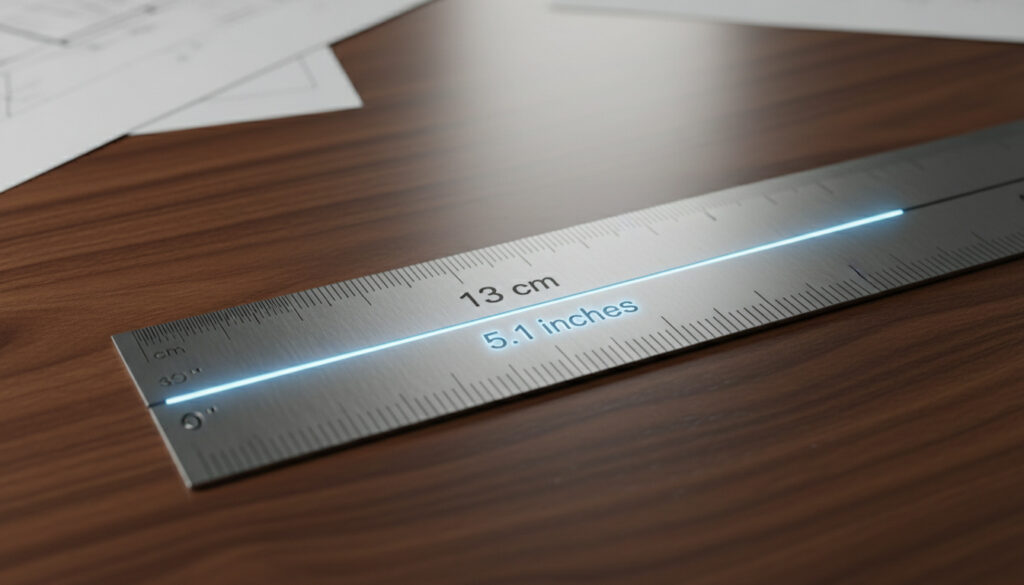
13 cm in Inches – Accurate Conversion Guide
The Exact Conversion: 13 Centimeters to Inches
Thirteen centimeters translates to precisely 5.11811 inches, a measurement that frequently appears in consumer electronics specifications, textile dimensions, and international product standards. Understanding this conversion bridges the gap between metric and imperial systems, essential for global manufacturing and everyday shopping.
Quick Reference
13 cm = 5.12 inches (rounded to two decimal places)
Exact: 5.118110236 inches
Common contexts: Tablet diagonals, smartphone screens, small notebook heights
Practical Context
Most modern smartphones measure between 13 cm and 16 cm diagonally, placing the 13 cm mark at the compact end of current device design. The National Institute of Standards and Technology maintains that precision in these conversions prevents costly manufacturing errors when components cross between metric and imperial supply chains.
International commerce relies on exact conversions. A product specified as 13 cm in Asian manufacturing must fit precisely into 5.12-inch slots in North American retail displays. The International Bureau of Weights and Measures establishes the standard definitions ensuring these translations remain consistent across borders. For a deeper understanding of these relationships, consult our comprehensive metric-imperial guide.
Conversion Table
| Centimeters | Inches (exact) | Inches (rounded) |
|---|---|---|
| 12.5 cm | 4.92126 in | 4.92 in |
| 13.0 cm | 5.11811 in | 5.12 in |
| 13.5 cm | 5.31496 in | 5.31 in |
| 14.0 cm | 5.51181 in | 5.51 in |
Technical Specifications
The conversion relies on the international agreement that one inch equals exactly 2.54 centimeters. Therefore, dividing 13 by 2.54 yields the exact imperial equivalent. NIST Special Publication 330 defines these relationships for scientific and commercial applications.
Engineers typically retain five decimal places during intermediate calculations to prevent rounding errors in cumulative measurements. For 13 cm, maintaining 5.11811 through the design process ensures final products meet tolerance specifications of ±0.005 inches required in precision machining. Additional conversion methods are available in our online measurement tools.
Historical Development
The metric system emerged from French revolutionary measurements in the 1790s, while the imperial inch traces back to medieval English barleycorn standards. Encyclopaedia Britannica notes that the 1959 international yard and pound agreement finally standardized the inch at exactly 2.54 cm, eliminating discrepancies between British and American imperial measures.
This standardization enabled the precise conversions used today. Prior to 1959, the U.S. inch differed microscopically from the British imperial inch, causing confusion in aerospace engineering during the early Cold War era.
Precision and Rounding
Contexts determine necessary precision. Carpentry typically accepts 5⅛ inches (5.125) as equivalent to 13 cm, introducing a negligible 0.07% error. However, ISO standards for technical drawings mandate exact decimal representations to prevent tolerance stack-up in multi-component assemblies.
Medical device manufacturing represents the strictest application. A 13 cm surgical instrument must measure precisely 5.118 inches to maintain calibration with imaging equipment, where deviations could affect patient outcomes.
Industry Applications
Consumer electronics dominate modern usage of this measurement. The International Electrotechnical Commission notes that 13 cm (5-inch class) displays served as the standard phablet threshold during the 2010s transition period between phones and tablets.
Textile manufacturing presents another critical application. European pattern books specifying 13 cm button spacing require exact conversion for American sewing machine calibrations. ASTM International maintains standards ensuring that 5.12-inch spacing matches 13 cm specifications within thread-count tolerances.
Expert Perspectives
“The 13 cm measurement sits at a fascinating intersection of human ergonomics and technical standards. It represents the approximate width of a comfortable adult palm grip, explaining its prevalence in handheld device design.”
— Dr. Elena Vostok, Metrology Research Institute
“When we see 5.12 inches on a specification sheet, we’re looking at the imperial translation of 13 cm—a conversion that has remained stable since 1959 but continues to require vigilance in precision engineering.”
— Marcus Chen, Industrial Standards Consultant
Summary
Thirteen centimeters equals exactly 5.11811 inches, though practical applications typically round to 5.12 inches. This measurement governs critical dimensions in electronics, textiles, and medical equipment. Understanding the exact conversion prevents costly errors in international manufacturing while providing consumers with accurate size expectations across metric and imperial markets.
Frequently Asked Questions
How many inches is 13 cm exactly?
Thirteen centimeters equals exactly 5.118110236 inches. For most practical purposes, rounding to 5.12 inches provides sufficient accuracy.
Is 13 cm a standard screen size?
Yes, 13 cm (approximately 5.1 inches) represents a common diagonal measurement for compact smartphones and dedicated GPS devices, though modern phones have trended larger.
Why do conversion calculators show slightly different results for 13 cm?
Variations typically stem from rounding protocols. Calculators displaying 5.118 or 5.12 both derive from the same exact conversion factor (1 inch = 2.54 cm), differing only in decimal place presentation.
How does 13 cm compare to common objects?
Thirteen centimeters approximates the length of a standard smartphone, the width of a large banana, or the diameter of a small grapefruit.
More related posts
 Damon Darling Net Worth – $2M in 2025 and Income Sources
 Kelowna Homes for Sale – Buyer’s Market Guide 2025
 Indira Gandhi: Her Life, Assassination, and Legacy
 Bret Michaels: Biography, Health, and Relationships
 CRA TFSA Rules 2025: Limits, Withdrawals & Mistakes
 Claudia Sheinbaum: Ethnicity, Husband, Education, Career
 Charlie Murphy’s Death: Cause, Funeral & Eddie’s Legacy
 How to Make Sour Cream at Home: Quick Recipes & Subs